
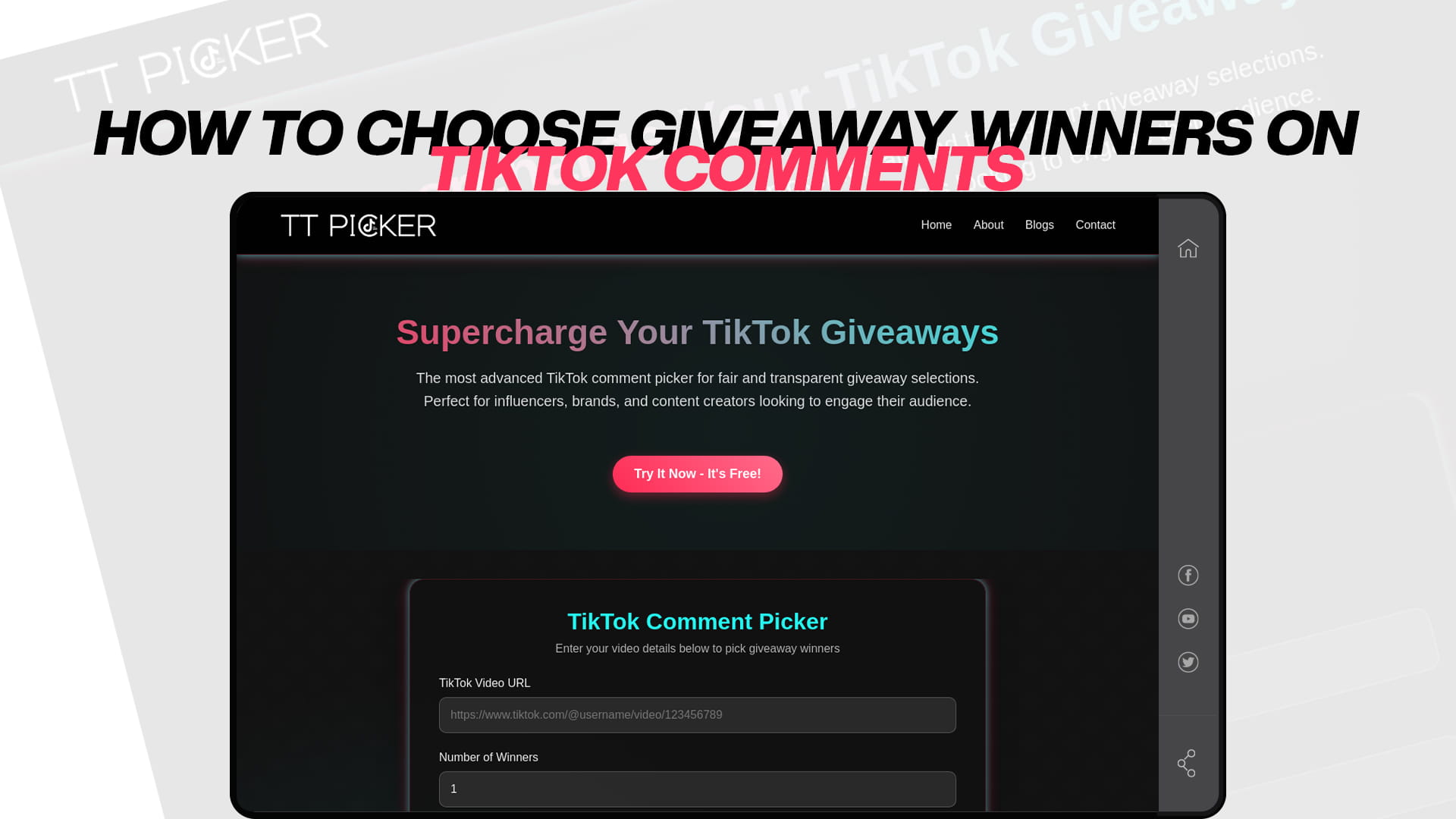
How to Choose Giveaway Winners on TikTok Comments
When you run a giveaway on TikTok, the comments are your entry list. People comment to enter, the comment section fills up, and at the end you have to choose a winner from that pile in a way that is fair and that your audience believes is fair. Those are two different things, and getting both right is what this guide is about.
Choosing a winner from comments is not just clicking a random name. It is about defining what counts as a valid entry, narrowing the comments down to those real entries, drawing genuinely at random, and being able to show your work. Do that and a giveaway becomes a trust-builder. Skip it and even an honest draw can look rigged.
Why comments are the entry method on TikTok
Before the how, a quick word on the why. TikTok does not let outside tools see who liked a video or pull your follower list for a draw, so those signals cannot be used to select a winner. Comments are different. On any public video with comments enabled, the comments are accessible, and more importantly, leaving a comment is a deliberate action a person takes to enter.
That comments the cleanest entry signal you have. It is public, it is tied to a specific person, and it only happens because someone chose to participate. This is exactly why almost every TikTok giveaway is comment-based, and why "comment to enter" is the standard instruction you see on giveaway videos.
Step one: decide what a valid entry looks like
A fair winner starts with clear entry rules, set before anyone comments. Vague rules are where disputes are born.
Decide how people enter and say it plainly on the video. The most common setup is to ask viewers to follow you, like the video, and comment, with the comment being the actual entry. Many creators add a keyword, asking entrants to comment a specific word or phrase, which makes valid entries easy to identify later. Others ask people to tag a friend, which doubles as a reach booster. Whatever you choose, keep it simple, because every extra hoop reduces the number of people who bother to enter.
Be careful with tagging requirements, though. Demanding that people tag a long list of friends runs against TikTok's 2026 policy on excessive tagging, so keep it light, like tagging one friend rather than ten.
Step two: gather the comments
When the giveaway closes at your stated deadline, you need every valid comment in one place. Doing this by hand on a popular video is miserable, because comments number in the hundreds or thousands and they keep loading as you scroll.
A comment picker solves this instantly. You copy the video's link, paste it into the tool, and it pulls the full comment pool in seconds, including the comments posted right before your cutoff. A dedicated tool like TT Picker does this from the URL alone, with no login, which is the fastest way to get from "giveaway closed" to "ready to draw."
One thing to check: make sure your tool reads all your comments rather than capping at a small number on a free plan. On a giveaway with a few thousand entries, a low free limit means most of your entrants are silently excluded, which is the opposite of fair.
Step three: filter the pool down to real entries
This is the step that turns a messy comment section into a clean entry list, and it is where fairness is actually enforced.
Apply keyword filtering if your rules required a specific word, so only comments containing it are eligible. Turn on duplicate filtering so someone who commented twenty times counts as a single entry rather than twenty chances, which is one of the most common ways people try to game a giveaway. Exclude your own account and anyone helping you run the contest. And if your rules say a person can only win once, remove past winners from the pool. Removing repeat entries is so central to a fair comment draw that there is a dedicated guide to running a comment picker without duplicates.
When you are done filtering, the pool should contain exactly the people who did what you asked, each represented once. That is the list you draw from.
Step four: draw the winner at random
With a clean pool, you make the actual pick. Run the draw and let the tool select at random from the eligible comments.
The quality of the randomness is worth understanding. Simpler tools use a standard random number generator, which is statistically fine for fairness. The strongest tools use a cryptographically secure generator, which cannot be predicted or influenced, and they display the eligible comments they drew from so the result is transparent rather than hidden. That visible pool is what lets you prove the outcome instead of just asserting it. There is a closer look at the method in this explanation of how a picker selects winners randomly.
Step five: handle multiple winners and backups
If you promised more than one prize, draw all your winners in a single pass rather than running the tool repeatedly, which a good picker supports. It removes each selected winner from the pool so the same person cannot be drawn twice.
Always pull a backup winner or two as well, even for a single-prize giveaway. Winners sometimes never respond, and an alternate ready to go saves you from reopening the whole process. Your published rules should already say that an alternate may be selected if the first winner does not claim the prize within a set time.
Step six: verify the winner against your rules
A picker can confirm that someone commented, but it cannot confirm that they followed you or liked the video, because TikTok does not expose those actions to tools. So before you announce, check the winner manually against any conditions beyond commenting.
If your rules required a follow and the drawn winner does not follow you, your rules should let you move to an alternate. This manual check is quick for a single winner and it protects the integrity of the giveaway. It is also why keeping your conditions reasonable matters, since every condition you add is one more thing you have to verify by hand on the winner.
Step seven: show that the draw was fair
Choosing the winner honestly is only half the job. Your audience has to believe it too, and belief comes from visibility.
Screen-record or screenshot the draw as it happens, capturing the eligible comments and the selected winner. Then make the announcement public, ideally in a follow-up video or LIVE where the process is on display, rather than quietly naming someone in a caption. This openness is exactly what TikTok's 2026 policy encourages, and it is the single best defense against the "this was rigged" comments that follow vague announcements. A recorded, public draw turns a skeptical runner-up into someone who saw for themselves that they simply were not picked this time.
Choosing winners for a multi-prize or tiered giveaway
Not every giveaway has a single prize. You might have a grand prize and several runner-up prizes, or three identical prizes for three winners. Choosing winners fairly for these takes a little planning but no extra stress.
The cleanest approach is to draw all your winners in one pass, which a good picker handles by selecting the number you specify and removing each winner from the pool as it goes, so nobody is drawn twice. For a tiered giveaway, you can draw in order, treating the first name pulled as the grand-prize winner and the next names as the runner-ups, or draw the full set and assign prizes afterward. Either way, decide and state the method before you draw, so the order is not something you appear to be deciding after seeing who won. There is a full walkthrough of selecting multiple winners in a single draw if your giveaway has more than one prize.
How comment draws go wrong, and how to avoid it
Most unfair-looking giveaways are not dishonest; they are just sloppy in ways that invite doubt. Knowing the common failure points lets you sidestep them.
Not removing duplicates is the classic one. If a spammer commented fifty times and you draw from the raw pool, they had fifty times the odds of everyone else, which is the opposite of fair. Drawing before the deadline, or after it but including late comments, also undermines the result. Counting comments that ignored your entry rule, such as people who never used the required keyword, quietly rewards the people who did not follow instructions. And announcing without showing anything leaves the door open for accusations no matter how clean the draw actually was.
Every one of these is solved by the same discipline: enforce your deadline, filter to valid de-duplicated entries, draw once, and record it. The tools do the heavy lifting, but the discipline is yours.
Comments versus other entry methods
You may wonder why comments specifically, rather than likes, shares, or follows. The answer is partly practical and partly about fairness. Comments are publicly accessible to tools and tied to a deliberate entry action, whereas TikTok does not let outside tools see who liked a video or pull a follower list to draw from. That is the one signal you can both gather and verify automatically.
It is also the most intentional. A like is a quick tap that someone might give without any thought of entering, but a comment, especially one with a required keyword, is a clear, deliberate "I want in." That intentionality is part of what makes a comment-based draw feel legitimate to your audience, because the people in the pool genuinely chose to participate.
That said, comments do double duty for you. Beyond serving as the entry, a flood of comments is one of the strongest signals you can send the TikTok algorithm, which tends to push posts with high comment activity to more For You pages. So a comment-to-enter giveaway is not just the fairest format to draw from, it is also the one that does the most for your reach while the contest is live. The entry method and the growth mechanism happen to be the same action, which is a large part of why comment giveaways have become the default on TikTok rather than just one option among many.
Choosing winners well builds your next giveaway
The way you choose a winner sends a message about who you are as a creator. A draw that is clearly random, visibly fair, and properly announced does more than settle one contest. It tells your whole audience that entering your giveaways is worth their time, which means more entries and more engagement next time.
There is real strategy in picking the right method for your contest, and this overview of the best ways to pick a winner for your TikTok contest compares the options. If part of your goal is reach as well as fairness, pairing your comment giveaway with the right tags helps, and the guide to TikTok giveaway hashtags that work covers which ones actually expand your audience.
Put the steps together, set clear rules, gather the comments, filter to real entries, draw at random, verify the winner, and show your work, and choosing a giveaway winner stops being a stressful guess and becomes the most trusted moment of your whole campaign.