
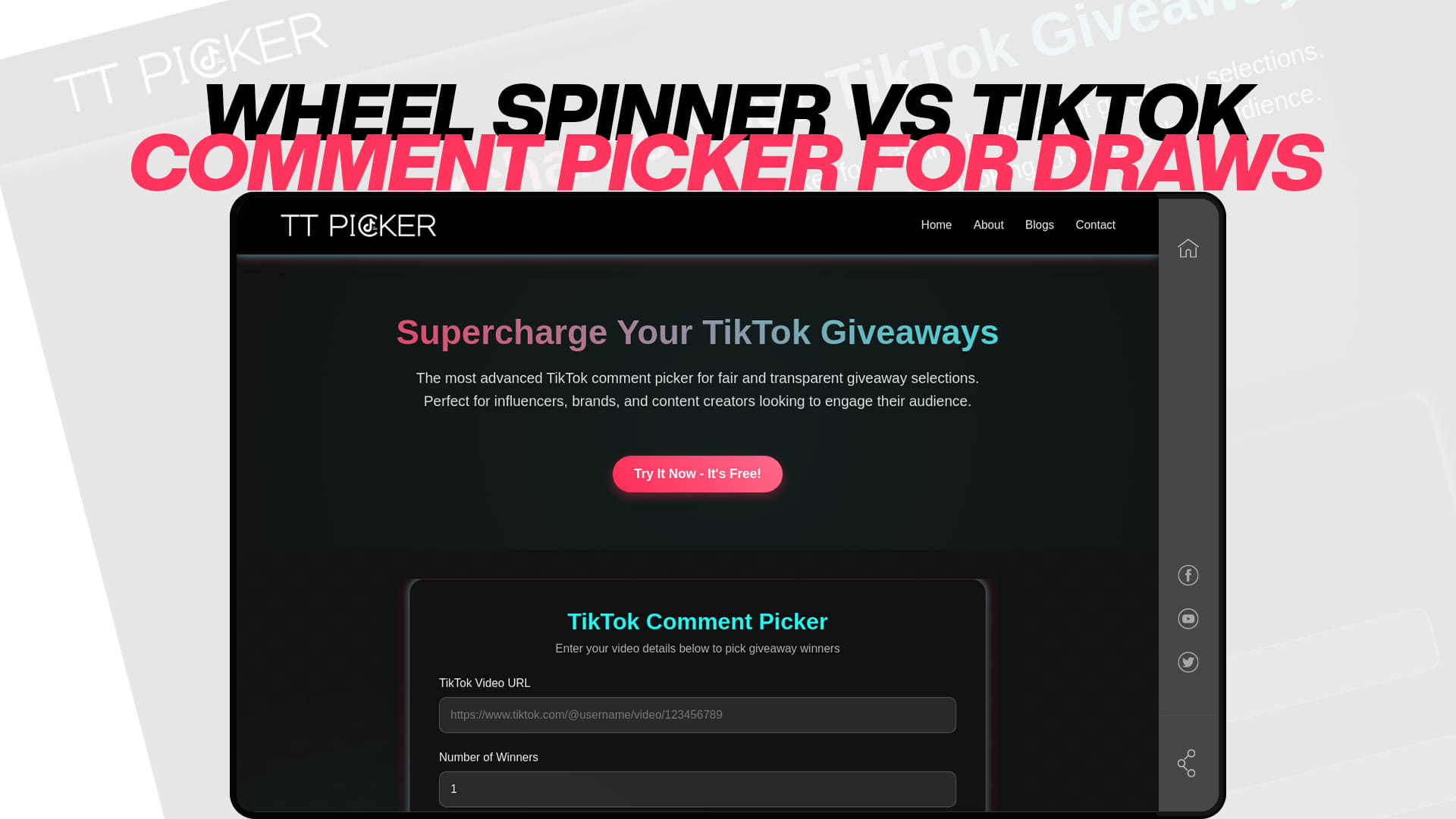
Wheel Spinner vs TikTok Comment Picker for Draws
Spin-the-wheel tools are everywhere, and it is easy to see why: watching a colourful wheel slow to a stop on a winner is genuinely satisfying, and it makes a great reveal on camera. So when it comes time to pick a TikTok giveaway winner, plenty of creators wonder whether a wheel spinner is the tool for the job. This guide compares a wheel spinner with a dedicated TikTok comment picker, honestly, so you know when the wheel is the right choice and when it will slow you down.
What each tool is built to do
The two tools are solving different halves of the problem, which is the key to the whole comparison.
A wheel spinner takes a list of names or options that you type or paste into it, splits them into coloured segments, and spins to land on one at random. It is a visual randomiser. Its whole job is the dramatic reveal, and it does that beautifully.
A TikTok comment picker takes the URL of your giveaway video, reads the comments automatically, filters them down to valid entries, and draws a winner. Its whole job is the end-to-end giveaway workflow: collecting the entries, cleaning them, and selecting fairly.
Notice the gap. The wheel spins a list you already have. The comment picker builds that list for you from TikTok. That difference is what decides which one fits your giveaway.
The catch with a wheel: you build the list yourself
A wheel spinner does not know what TikTok is. It cannot read your video's comments, so before you can spin, you have to get every entrant onto the wheel yourself.
For a TikTok giveaway, that means collecting the comments by hand or with a separate tool, cleaning out the duplicates so nobody appears on the wheel five times, removing comments that ignored your keyword, stripping your own account, and then typing or pasting the finished list into the wheel. That collection and cleaning is the hard part of running a giveaway, and the wheel leaves all of it to you. The spin itself, the fun bit, is the easy part that was never really the problem.
This is the same limitation that applies to any general randomiser: it draws from a list, but it will not build or clean that list from your TikTok comments. The busywork is yours.
The scale problem
Even setting aside the manual entry, a wheel runs into a hard practical wall: it does not scale.
A wheel with ten names is clear and fun. A wheel with two hundred names is an unreadable blur of slivers. A wheel with two thousand entrants, which a popular giveaway easily attracts, is completely unusable, since you cannot type them all in and could not see them if you did. Wheels are designed for a small number of options, so the moment your giveaway is bigger than a handful of entrants, the wheel stops being practical regardless of how fun it looks.
A comment picker has no such limit. It handles thousands of comments as easily as ten, because it is built to read and draw from large pools, which is exactly the situation a real TikTok giveaway creates.
Where the wheel genuinely shines
None of this means wheels are useless. They have a real strength that a plain draw does not: the reveal is entertainment.
For a small giveaway with a handful of entrants, a wheel is a delightful way to pick, especially on a LIVE where your audience watches it spin in real time. The suspense of the slowing wheel is genuinely engaging, and it turns the selection into a moment rather than a click. For that specific use, few entrants, live audience, drama wanted, a wheel is a lovely choice.
The wheel's problem is never the spin. It is everything before the spin, the collecting and cleaning, and everything about scale. So the smart approach is to keep the wheel's strength, the dramatic reveal, while getting rid of its weaknesses.
The best of both: shortlist, then spin
Here is how experienced creators get the wheel's drama without its busywork. They use a comment picker to do the heavy lifting, then use a wheel only for the finale.
The flow looks like this. Run your giveaway, then load the video into a TikTok comment picker, which reads every comment, removes duplicates, applies your keyword, and gives you a clean, valid entry pool in seconds. If you want the wheel moment, have the picker draw a small shortlist, say the final five, then drop those five names onto a wheel for a dramatic live spin to choose the winner. You get the airtight, fair, large-scale collection and filtering from the picker, and the entertaining reveal from the wheel, with none of the manual list-building.
Even simpler, some comment pickers include their own animated reveal, so you get a fun visual selection built right into the tool without touching a separate wheel at all. Either way, the picker does the part that has to be done right, and the animation is just the show on top. The duplicate filtering that keeps the shortlist honest is covered in the guide to a comment picker without duplicates.
A note on fairness
People sometimes ask whether a wheel is "more random" than a comment picker, or the other way around. In practice, both are fair when they select without bias, and a reputable version of either gives every name on it an equal chance. The strongest comment pickers use a cryptographically secure method, which is as unbiased as it gets, and a well-made wheel is random too.
So fairness is not really the deciding factor between them, because both are fair enough. The deciding factor is the workflow: whether the tool can collect and clean your TikTok entries, and whether it can handle your giveaway's size. On those, the comment picker wins decisively, and the wheel's advantage is purely the reveal. The mechanics behind a picker's randomness are covered in the guide to how it selects winners randomly.
Setting up a shortlist-to-wheel draw, step by step
If the combined approach appeals, here is exactly how to run it, because it is simpler than it sounds and gives you the best of both tools.
Start by running your giveaway normally, with a comment as the entry and a keyword if you want clean filtering. When it closes, paste the video link into your comment picker and let it read every comment. Apply your filters, remove duplicates so nobody appears more than once, keep only comments with your keyword, and exclude your own account. Now set the picker to draw a small shortlist rather than a single winner, for example five names, and run that draw, ideally recording it so the shortlist itself is provably fair. Take those five names and type them onto a wheel. Then, live or on camera, spin the wheel for the finale.
The important detail is that every fairness-critical step happened in the picker: the full pool was read, cleaned, and drawn from fairly to produce the shortlist. The wheel only chooses among five already-legitimate finalists, so even though a wheel could not have handled your two thousand entrants, it does not need to, since it is only ever spinning five names. You get airtight fairness and the crowd-pleasing spin.
Common wheel mistakes on TikTok
A few errors turn a fun wheel into an unfair or unconvincing draw, and they are easy to avoid once you know them.
The first is putting your entire large entry list on the wheel, which is either impossible or produces an unreadable, unusable wheel, and tempts people to trim the list in ways that are not random. The second is manually typing names onto the wheel and accidentally leaving people out or entering someone twice, which quietly breaks the fairness before you even spin. The third is using the wheel as your collection method, scrolling comments and adding names by hand, which reintroduces every bias and error of manual picking. And the fourth is spinning without any record, so that although the wheel looks fair on screen, you cannot show how the names got onto it in the first place.
The fix for all four is the same: let a comment picker build and clean the pool, use the wheel only for a small shortlist, and record both steps. Then the wheel is pure entertainment sitting on top of a fair process, which is exactly what it should be.
Which should you use?
Match the tool to your giveaway. If you have a large or normal-sized TikTok giveaway, use a comment picker; it is the only one of the two that can actually collect and clean your entries and handle the volume. If you have a tiny giveaway with a few entrants and you want a fun live reveal, a wheel is a charming choice. And if you want both, the fairness and scale of the picker plus the drama of a wheel, use the picker to produce a clean shortlist and spin the wheel for the finale, or use a picker with a built-in animated draw.
For most TikTok giveaways, the comment picker is the workhorse and the wheel is an optional flourish. The full campaign flow, including where the draw fits, is in the step-by-step giveaway guide.
A wheel spinner is a wonderful way to reveal a winner and a poor way to run a giveaway, because it spins a list it cannot build and cannot scale. A comment picker is the reverse: it does the collecting, cleaning, and fair drawing that a real TikTok giveaway needs. Use the picker for the job and, if you love the drama, let a wheel handle the final flourish, and you get the best of both without the busywork.
Frequently Asked Questions
No. A wheel spinner only spins a list of names you type or paste into it. It has no connection to TikTok, so you would have to collect and clean your comments yourself first. A comment picker reads the comments directly from the video URL, which is the main practical difference.
A reputable wheel is fair, giving every name on it an equal chance, so randomness is not the issue. The problem is that you have to build the list yourself, and that a wheel becomes unusable with more than a small number of entrants, not that the spin is unfair.
Because wheels do not scale. A handful of names is clear and fun, but a few hundred is an unreadable blur, and a few thousand is impossible to enter or display. Popular giveaways easily reach those sizes, which is why a comment picker, built for large pools, is the practical choice.
Yes, and it is a great approach. Use the comment picker to read your comments, remove duplicates, apply your keyword, and draw a small shortlist, then put those few names on a wheel for a dramatic live spin. You keep the fairness and scale of the picker and the entertainment of the wheel.
Some do. Many pickers include an animated reveal so you get a fun visual selection without a separate wheel. Either way, the animation is just the presentation; the important work is the collecting, filtering, and fair drawing that the picker does underneath.