
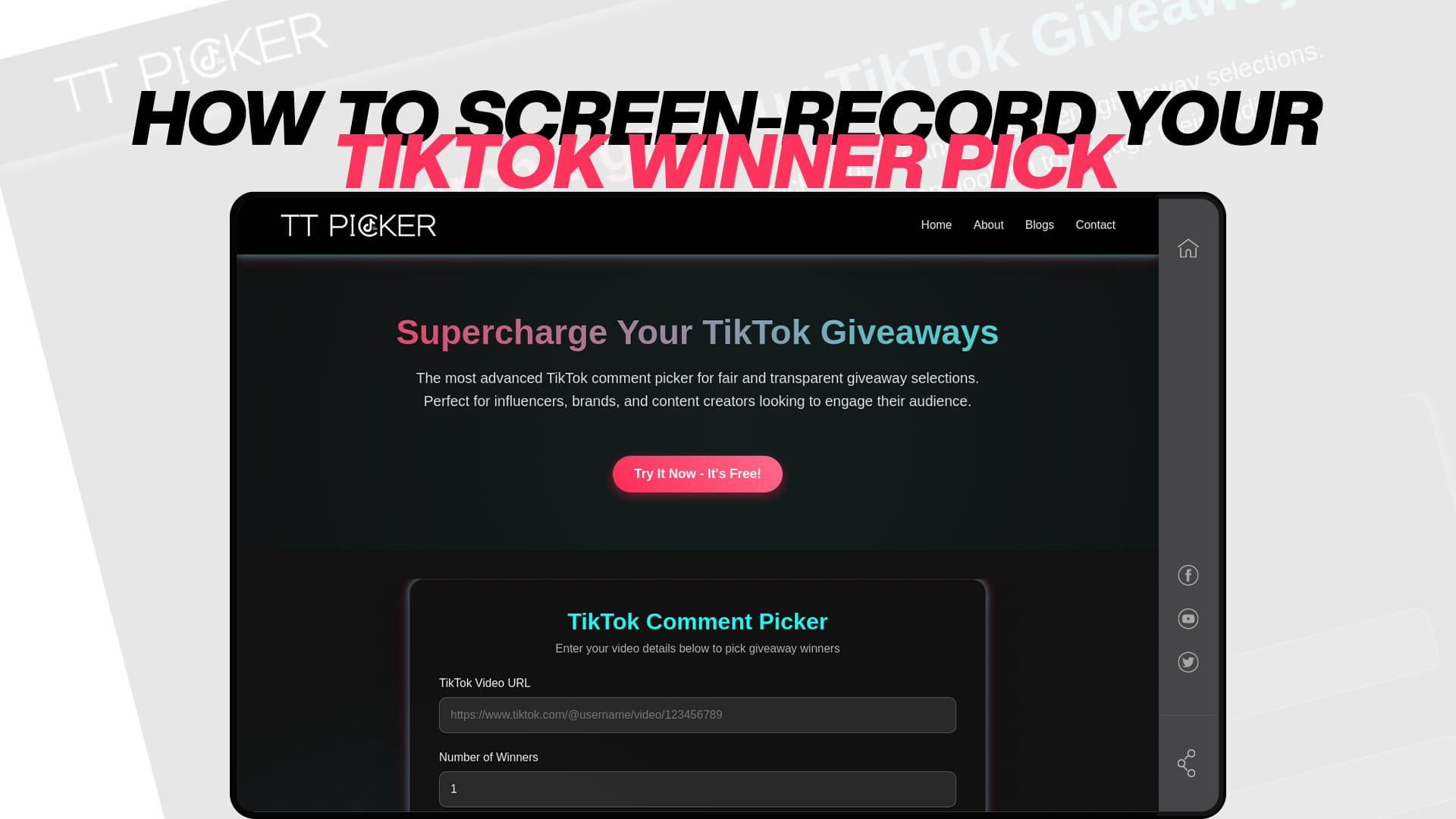
How to Screen-Record Your TikTok Winner Pick
The difference between a giveaway people trust and one they quietly suspect is usually a single thing: proof. A name announced with nothing behind it invites the "this was rigged" comments. That same name, shown being drawn on a recording anyone can watch, ends the argument before it starts. Screen-recording your winner pick is the easiest way to make your giveaway believable, and it takes about a minute.
This guide covers how to screen-record your draw on iPhone and Android, what to actually capture so the recording proves something, and how to turn it into a reveal that builds trust instead of doubt.
Why record the draw at all
It helps to be clear about what a recording does, because it is doing more work than it looks.
Nobody watching your giveaway can see inside your process. When you announce a winner, all your audience has is your word that the draw was fair, that the pool was real, and that you did not just pick a friend. A recording replaces your word with evidence. It shows the eligible entries going in, the random selection happening, and the winner coming out, all in one unbroken clip. A skeptical runner-up can watch it and see for themselves that they simply were not picked this time.
There is also a platform reason. TikTok's 2026 giveaway policy pushes creators toward transparency, and a recorded draw is the cleanest way to demonstrate it. And there is a scam-prevention angle: a public, recorded reveal from your own account gives your audience a single authoritative source to trust, which makes it harder for impersonators to convince entrants that some other "winner" message is real.
In short, the recording is not decoration. It is the thing that converts a claim into proof.
How to screen-record on iPhone
iPhone has screen recording built in, so you do not need any app. You may need to add the button first.
Go to Settings, then Control Center, and add Screen Recording to your included controls if it is not already there. Then open Control Center by swiping down from the top-right corner, tap the round record button, wait for the three-second countdown, and everything on your screen is now being captured. Do your draw. When you are done, tap the red status indicator at the top of the screen and confirm stop, and the video saves straight to your Photos.
A couple of tips. If you want to narrate the reveal, press and hold the record button first and turn the microphone on, so your voice is captured alongside the screen. And turn on Do Not Disturb before you record, so a notification banner does not pop up over your draw, both for a cleaner video and to avoid exposing a private message on screen.
How to screen-record on Android
Android also has a built-in screen recorder on essentially all modern phones, though the exact wording varies slightly by manufacturer.
Swipe down from the top of the screen to open the Quick Settings panel, then swipe again to see the full set of tiles. Look for Screen Record or Screen Recorder, and tap it. You will usually get a prompt asking whether to record audio, choose whether you want your microphone on for narration, and whether to show screen touches, which can actually be nice for a draw since it shows you are really tapping the buttons. Tap start, wait for the countdown, and do your draw. To stop, swipe down and tap the recording notification, and the video saves to your gallery.
If you cannot find the tile, you can add it by tapping the edit or pencil icon in the Quick Settings panel and dragging Screen Record into your active tiles. On the rare device without a native recorder, a reputable screen recording app does the same job.
What to actually capture
A recording only proves something if it captures the right things. A ten-second clip of just the winner's name appearing proves nothing, because it does not show where that name came from. Capture the whole story.
Start the recording before you draw, not after. Show the eligible pool: the comments loaded into your picker, ideally after your filters are applied, so viewers can see the real entry list. If you filtered for a keyword or removed duplicates, showing the filtered pool demonstrates that only valid entries were eligible. Then show the actual selection happening, the button press and the winner being drawn, in the same continuous clip, with no cut between the pool and the result. Finally, let the winner's name sit on screen clearly enough to read.
The key word is continuous. A recording that cuts from "here are the comments" to "here is the winner" invites suspicion about what happened in the gap. One unbroken take from pool to winner is what makes it airtight. Using a tool that visibly shows the eligible entries it is drawing from makes this easy, which is part of what the comment picker is built to do, and the mechanics of the selection itself are explained in the guide to how a picker selects winners randomly.
Recording a keyword or duplicate-filtered draw
If your giveaway used a keyword or you removed duplicate entries, your recording is even more persuasive when it shows those steps, because it demonstrates the fairness rather than just asserting it.
Capture the moment you apply the keyword filter, so viewers see the pool narrow to only valid entries. Show the duplicate filter doing its work, collapsing repeat comments so each person has one chance. Then draw. Now your recording is not just proof of a random pick, it is proof of a clean, rule-following process from start to finish. This matters most on big or spam-heavy giveaways, and the reasoning behind duplicate removal is covered in the guide to a comment picker without duplicates.
Turning the recording into your announcement
Once you have the clip, it becomes the centrepiece of your winner reveal, and you have a few good options.
Post it as a dedicated announcement video, with the draw as the main content and a caption naming the winner and the claim instructions. This is the strongest format, because the proof and the announcement are the same post. Alternatively, include the recording as a segment within a longer reveal video, where you talk to camera and then cut to the screen recording of the draw. Or, if you drew live, the LIVE itself is your recording, and you can save and repost the relevant clip afterward.
Whichever you choose, reference the recording in your caption, something like "the full draw is in this video, no edits," so people know the proof is there. That single line, backed by the clip, is what makes the announcement land. The broader flow from draw to announcement is covered in the guide to picking a winner from TikTok comments online.
Protecting privacy while you record
One caution: a screen recording captures everything on screen. Before you record, make sure nothing private is visible.
Turn on Do Not Disturb so incoming message previews do not appear over your draw. If your picker or browser shows anything sensitive, close it. And be mindful that the winner's username will be visible in the recording, which is usually fine since they entered publicly, but if a winner later asks to stay anonymous, you may need to blur their handle before resharing the clip widely. Capturing the process is the goal; capturing your notifications or a private DM is not.
Should you narrate the draw?
Whether to talk over your recording is a small choice that changes how the reveal feels, and both options work.
A narrated draw, where you speak as you load the comments, apply the filters, and press draw, adds personality and makes the reveal feel like an event. It also lets you explain what you are doing in real time, which reinforces the fairness for anyone who does not know how a picker works. "Here are all the comments, I am removing the duplicates now, and the winner is..." is genuinely reassuring narration. The trade-off is that it takes a steadier hand and a bit of confidence on camera.
A silent draw, just the screen recording with no voice, is cleaner, faster, and easier to drop into a larger edited video where you talk to camera separately and then cut to the screen recording as proof. Many creators prefer this because it separates the personality part from the evidence part.
Neither is more legitimate than the other, since the proof is in what the screen shows, not in your commentary. Pick whichever suits your style and the format of your announcement. If you are drawing live on a LIVE stream, the narration happens naturally, and the stream itself becomes your recording, which is why LIVE draws feel so transparent to the people watching.
Recording a draw for multiple winners
If your giveaway has several prizes, the recording matters even more, because you want to prove that all the winners came from one fair draw rather than a series of separate picks.
Capture the moment you set the winner count and draw all the names at once, so the recording shows the full set of winners emerging together from the same pool. This is what lets you honestly say no name could come out twice and that the whole slate was drawn in a single event. If your prizes are tiered, the draw order is visible in the recording too, which backs up your stated rule about assigning prizes by the order names came out. One continuous clip of a multi-winner draw is far more convincing than announcing winners one at a time across several posts.
Common recording mistakes
A few easy errors undercut an otherwise good recording. Starting the recording after the draw, so it only shows the result and not where it came from, defeats the purpose. Cutting or editing between the pool and the winner, which reintroduces the doubt the recording was meant to remove. Recording a screen so cluttered or fast that nobody can actually read the entries or the winner. And forgetting to silence notifications, so a banner covers the key moment or leaks something private.
Avoid those and your recording does exactly what it should: show, in one clear, continuous take, that the winner came from a real pool through a random draw.
Screen-recording your winner pick is a one-minute habit that pays for itself the first time someone questions a result, and you simply point at the video. Capture the whole draw in one continuous take, from the filtered pool to the winner, silence your notifications, and make the clip the centrepiece of your announcement. Do that, and your giveaways stop being something people take on faith and become something they can see is fair.
Frequently Asked Questions
You are not legally required to, but it is the single most effective way to make your giveaway trustworthy. A recording turns "trust me, it was random" into something your audience can actually watch and verify, which prevents the accusations that follow vague announcements and aligns with TikTok's 2026 push toward transparency.
On iPhone, add Screen Recording in Settings, then open Control Center and tap the record button. On Android, open Quick Settings, tap Screen Record, and confirm. Both save the video to your photos or gallery, and both let you turn on the microphone if you want to narrate the reveal.
Show the whole draw in one continuous clip: the eligible comments loaded into your picker, any keyword or duplicate filtering being applied, the selection happening, and the winner's name clearly on screen. The key is that it is unbroken, since a cut between the pool and the result reintroduces doubt.
Yes. Turn on Do Not Disturb so message previews do not pop up over your draw, both for a cleaner recording and to avoid accidentally showing a private message on screen. A stray notification banner can also cover the exact moment you are trying to capture.
You can trim the start and end, but do not cut between showing the pool and showing the winner, since that gap is exactly what makes people suspicious. The value of the recording is that it is continuous, so keep the pool-to-winner moment intact and unedited.