
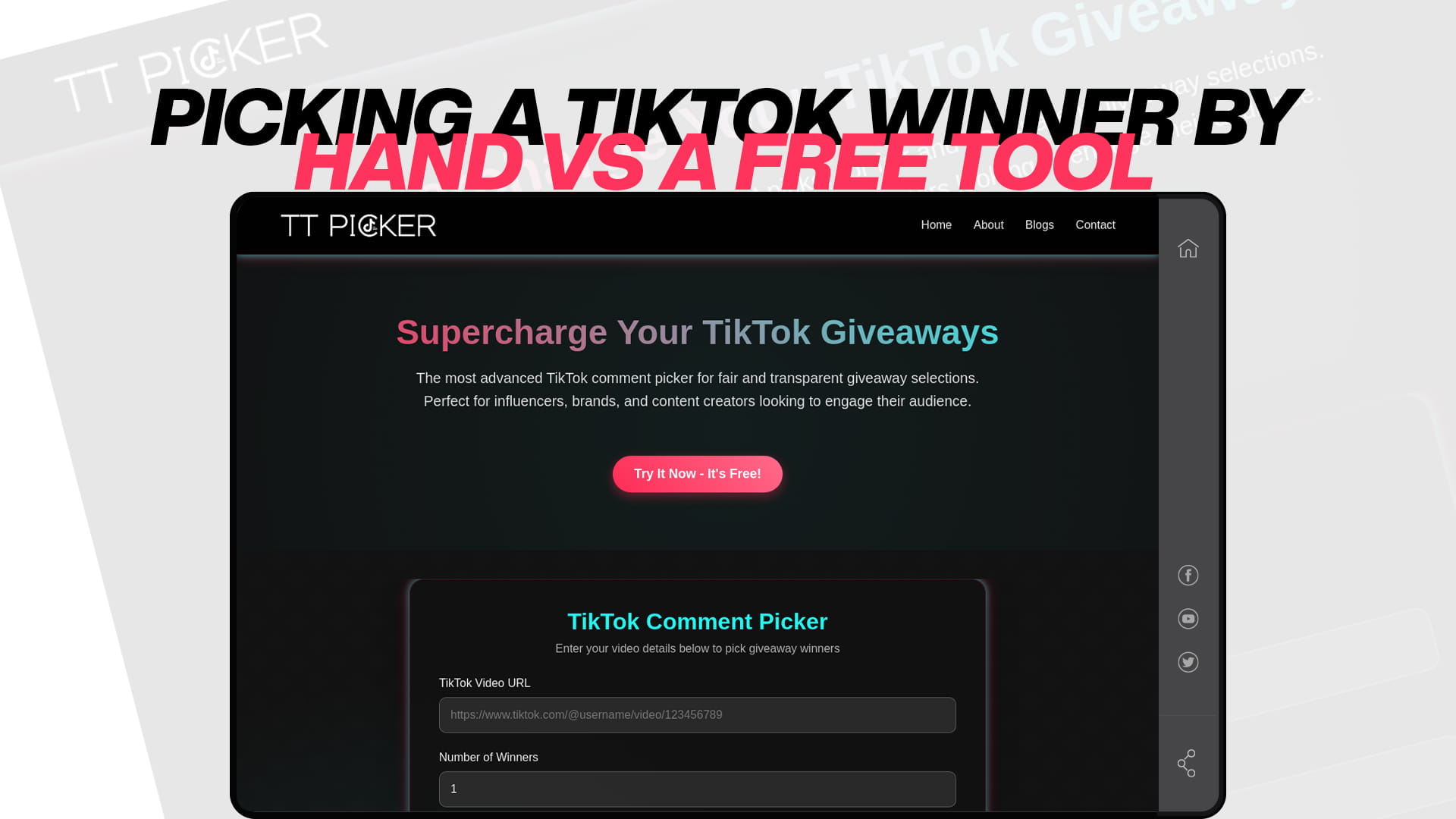
Picking a TikTok Winner by Hand vs a Free Tool
When your giveaway closes, you have two ways to pick a winner: do it by hand, scrolling the comments and choosing one, or paste the video into a free tool that draws one for you. Plenty of creators start out doing it by hand because it feels simpler. Then the giveaway grows, the comments pile up, someone accuses them of rigging it, and they switch. This guide walks through both approaches honestly, so you can skip straight to the one that actually serves you.
What "by hand" actually means
Picking by hand covers a few different methods, and all of them have the same underlying problems.
The most common is scroll and stop: you scroll through the comments and pick one that catches your eye, or stop your thumb at a "random" moment. Another is the counting method: you decide on a number, count that far down the comments, and pick whoever lands there. A third is the screenshot method: you screenshot the comments, maybe number them, and choose. And some people copy comments into a notes app or spreadsheet and pick from there.
They feel different, but they share a core issue. Every one of them depends on you handling the comments manually, which is where bias, error, and doubt creep in. Let us look at what that costs.
Why picking by hand is harder than it looks
The problems with manual picking are not obvious until you hit them, usually at the worst moment.
It is not actually random. Scroll and stop feels random but is not; you are biased toward comments near the top, recent ones, ones with lots of likes, or names you recognise. Human beings are famously bad at being random, and a determined skeptic can feel the difference. Even the counting method is skewed by the order TikTok loads comments in, which is not neutral.
It does not scale. Picking by hand from twenty comments is annoying; from two thousand it is impossible. TikTok loads comments as you scroll, so you can never be certain you have seen them all, which means some entrants literally never had a chance of being picked.
It ignores duplicates and invalid entries. If someone commented forty times, scrolling past their comments gives them forty times the chance of being spotted. And if your rules required a keyword, you are left eyeballing every comment to check, which nobody does reliably.
And it leaves you with no proof. When you announce a hand-picked winner, all your audience has is your word. There is no recording of a fair pool and a fair draw, just a name, which is exactly the setup that invites "this was rigged" comments, even when you were completely honest.
What a free tool does instead
A free comment picker exists specifically to solve every one of those problems, and it does the whole job from the video link.
You paste the giveaway video's URL into a TikTok comment picker, and it reads every public comment automatically, no scrolling, no missing anyone. It filters the pool for you: duplicate filtering collapses repeat commenters to one entry each, keyword filtering keeps only comments that followed your rule, and exclusions remove your own account. Then it draws a winner at random using a method that cannot be nudged or predicted, and you can record the whole thing as proof.
So the tool turns a slow, biased, unprovable chore into a few seconds of genuinely random, fully documented selection. The mechanics of the draw itself are explained in the guide to how a picker selects winners randomly, and the duplicate handling that manual picking cannot match is covered in the guide to a comment picker without duplicates.
The speed difference is not close
Consider a giveaway with a thousand comments. By hand, you are scrolling for many minutes, trying to account for duplicates you cannot really track, hoping you did not miss a chunk, and ending up with a pick you cannot prove was fair. With a tool, you paste the link, toggle your filters, and draw, in well under a minute, with a recording to show for it.
The gap only widens as your giveaways grow. The manual method gets linearly more painful with every comment, while the tool handles a thousand comments as easily as ten. For anything beyond a tiny giveaway, the time saved alone justifies the switch, before you even count the fairness and proof benefits. The full flow from link to winner is in the guide to picking a winner from TikTok comments online.
The fairness and trust difference
This is the part that matters most, and it is where hand-picking quietly damages creators.
A giveaway is supposed to build goodwill. The moment a runner-up suspects the draw was not fair, that goodwill turns to resentment, and hand-picked winners are magnets for suspicion because there is nothing to show. Even if you were scrupulously honest, "I scrolled and picked" is not something anyone can verify.
A tool plus a recording flips this completely. When you can show the eligible pool and the random draw happening, a losing entrant sees for themselves that they simply were not picked. The accusation never gets traction because the evidence is right there. In a space where trust is the entire currency of a giveaway, provable fairness is not a nice-to-have; it is the point.
When picking by hand is actually fine
To be fair to the manual method, there are situations where it is genuinely okay, and it would be dishonest to pretend otherwise.
If your giveaway is tiny, say a handful of comments among friends or a small community where everyone trusts you, hand-picking is fine because the stakes and the volume are both low. If the prize is trivial and nobody is going to scrutinise the result, the overhead of any process is more than the situation needs. And if you are doing a genuinely informal "first person to comment wins" or "I'll pick my favourite reply," that is a different kind of selection where randomness is not even the goal.
But notice that even in these cases, a free tool is not harder; it is just optional. The moment your giveaway has real entrants, a real prize, or an audience that might question the result, the manual method stops being simpler and starts being a liability.
The counting method deserves a special mention
A lot of creators believe the counting method, deciding on a number in advance and picking whoever lands at that position, is a fair, honest alternative to eyeballing a comment. It feels more rigorous, so it is worth explaining why it still falls short.
The problem is that TikTok does not show comments in a neutral order. Comments are sorted and loaded by TikTok's own logic, which can favour popular comments, replies, or recent activity, and that order can shift as new comments come in or as you scroll. So when you count to your chosen number, you are not counting through a random arrangement; you are counting through TikTok's arrangement, which means certain comments are systematically more or less likely to land at your number. It looks fairer than scroll-and-stop, but it has simply hidden the bias inside the comment ordering rather than removed it.
There is also the practical issue that you still have to scroll to reach your number, you still cannot easily account for duplicates, and you still cannot prove any of it afterward. The counting method is more effort than scroll-and-stop for the same fundamental flaws, which is the worst of both worlds.
Switching is instant, and free
If you have been picking by hand, the switch to a tool is not a project. There is nothing to install, no account to create, and no cost.
You copy your giveaway video's link, paste it into a free comment picker, and you are already ahead of where hand-picking would leave you: every comment loaded, duplicates handled, keyword checked, and a random draw ready to record. The first time you do it, the contrast with scrolling through hundreds of comments is stark, and most creators never go back. The tool does in one step what the manual method does in many, and it does the parts- real randomness and provable fairness- that the manual method cannot do at all.
That is really the whole case. Hand-picking is not simpler once you account for what it costs you, and the alternative is free and faster, so the only giveaways still worth doing by hand are the ones too small to matter.
The honest verdict
For any giveaway that matters, a free tool wins, and comfortably. It is faster, it is genuinely random rather than subtly biased, it handles duplicates and keywords that manual picking cannot, and it gives you the proof that protects your reputation. Picking by hand only holds up for tiny, casual, low-stakes draws, and even then the tool is no more effort.
The switch costs nothing, since a good comment picker is free, and it removes the two things that make hand-picking risky: the hidden bias and the missing proof. Once your giveaways have any real audience, running the draw through a tool is simply the professional way to do it, and the step-by-step giveaway guide shows where that draw fits into the whole campaign.
Picking by hand feels simpler, but it trades away speed, real randomness, and proof, three things a giveaway cannot afford to lose once it has an audience. A free tool gives all of them back at no cost and in less time, which is why the creators who look most trustworthy almost never pick by hand. Save the manual method for the tiny, casual draws where it genuinely does not matter, and let a tool handle everything else.
Frequently Asked Questions
Not really. Scrolling and stopping is biased toward comments near the top, recent ones, or those with many likes, and humans are poor at being genuinely random. Even counting to a number is skewed by the order TikTok loads comments. A tool using a proper random method is the only way to be genuinely unbiased.
Because it is slow, it is not truly random; it cannot account for duplicate entries or check keywords, and it gives you no proof the draw was fair. On a popular video, you also cannot be sure you saw every comment, meaning some entrants never had a chance. A free tool fixes all of that in seconds.
Yes, a good one is free for its core features, including reading your comments, filtering duplicates and keywords, and drawing a winner, with no login or download. That is what makes hand-picking hard to justify: the tool is faster and fairer at no cost.
For tiny, casual, low-stakes giveaways, a handful of comments among people who trust you, hand-picking is fine. It also applies when randomness is not the goal, like "first to comment" or "my favourite reply." For anything with real entrants, a real prize, or an audience that might question it, use a tool.
A tool lets you show the eligible pool and record the random draw, so a losing entrant can see for themselves that the selection was fair. Hand-picking leaves you with only your word, which is exactly what invites suspicion. Visible, recorded fairness is what shuts the accusations down.