
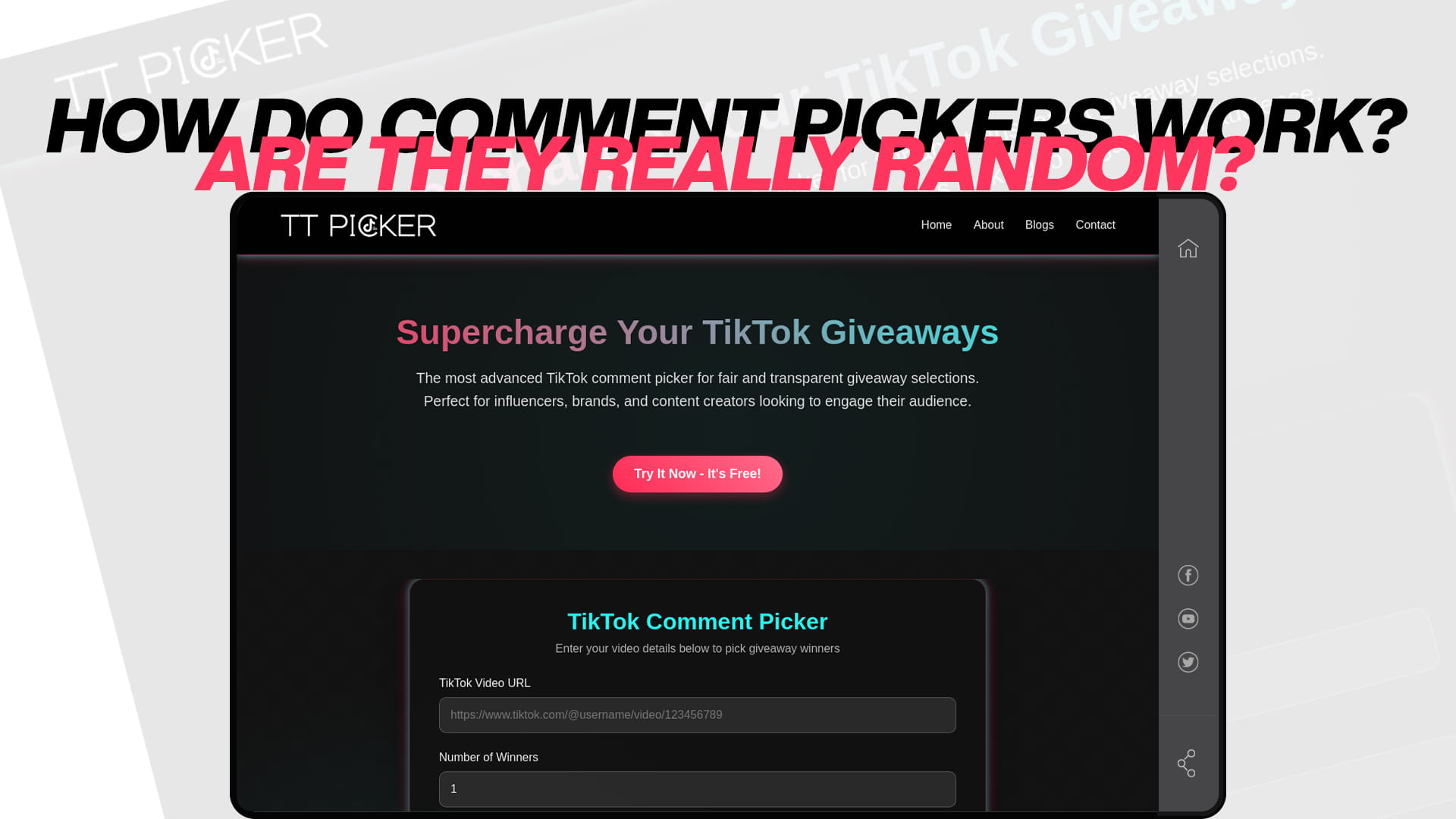
How Do Comment Pickers Work? Are They Really Random?
Every giveaway ends the same way: a tool spins, a name appears, and somewhere in the comments a runner-up wonders whether the whole thing was actually random or just theater. It is a fair question. When a comment picker announces a winner, you are trusting a piece of software you cannot see inside, and "trust me, it was random" is not much of an answer.
So let's open the box. This guide explains what actually happens between pasting a video link and seeing a winner's name, what "random" really means in software, whether a draw can be rigged, and how you, as a creator or an entrant, can tell a fair draw from a suspicious one.
What happens when you paste a link
The first half of a comment picker's job has nothing to do with randomness at all. It is data collection.
When you paste a TikTok video or photo post URL into a picker, the tool reads the public comments attached to that post. It can only see what anyone on the internet could see: public comments on a public post with commenting enabled. It cannot read private accounts, cannot see who liked the video, and cannot pull your follower list, because TikTok does not expose that data. What it ends up with is a list of comments, each tied to a username.
Next come the filters, which are where fairness is actually enforced. Duplicate filtering collapses repeat comments from the same user into a single entry, so nobody buys extra odds by spamming. Keyword filtering keeps only comments containing a required word, if your rules used one. Exclusion lists remove your own account, your team, or past winners. What remains is the eligible pool: one entry per qualifying person.
Only then does the random part happen. The tool picks one entry, or several, from that pool. Everything about whether the draw is fair comes down to how that pick is made.
What "random" actually means in software
Here is the uncomfortable truth about computers: they cannot produce true randomness on their own. A computer is a machine that follows instructions exactly, so any "random" number it produces comes from an algorithm. These algorithms are called pseudo-random number generators, or PRNGs.
That word "pseudo" sounds damning, but it is not. A good PRNG produces output that is statistically indistinguishable from true randomness: every entry has an equal probability of being chosen, there is no detectable pattern, and no bias toward the first comment, the longest comment, or the person with the most followers. For the purposes of a giveaway, that is what fairness requires, and most reputable comment pickers use exactly this and are entirely fair in practice.
There is a stronger tier, though. Cryptographically secure pseudo-random number generators, or CSPRNGs, are the class of generator used in encryption and security software. Their defining property is unpredictability: even someone who knows the algorithm and watches its output cannot predict the next result or steer it. A picker built on a CSPRNG, ideally paired with a proper unbiased shuffling method such as Fisher-Yates, is drawing from the same quality of randomness that protects your bank login. This is the approach TT Picker takes, and it is the difference between "random enough that no one could tell" and "random in a way that can be defended mathematically." The deeper mechanics are laid out in this explanation of how the tool selects winners randomly.
The practical takeaway: the question is rarely whether a reputable picker's algorithm is random enough. It is whether the process around the algorithm was honest.
So can a comment picker be rigged?
In principle, any software can be built dishonestly, so the honest answer is that a maliciously built tool could favor certain entries and you would struggle to tell from a single draw. But this is the wrong place to focus your suspicion, for a simple reason: a reputable picker has everything to lose and nothing to gain by rigging draws for strangers, and statistical bias in a widely used tool would eventually surface across thousands of draws.
The realistic ways giveaways actually get rigged are much more mundane, and they happen outside the algorithm. A host can re-run the draw until a preferred name comes up, and only show the final spin. A host can quietly exclude entries that were valid, or include friends who never entered. A host can skip the tool entirely, pick a name by hand, and claim it was random. None of these require hacking a random number generator. They just require an audience that cannot see the process.
Which is exactly why transparency, not the algorithm, is the real test of a fair giveaway. An honest host draws once, on the record, from a visible pool. The randomness does the fairness; the visibility does the trust.
How to prove your draw was fair (as a creator)
If you run giveaways, a few habits make your draws essentially beyond reproach.
Show the pool. Use a tool that displays the eligible comments it is drawing from, so the audience can see the winner came from a real, filtered list rather than thin air. Record the draw, a screen recording or LIVE of the actual moment, and share it with your winner announcement. Draw once, and commit to the result; re-rolling because you did not like the outcome destroys the entire point. State your filters up front, in your rules, so nobody wonders afterward why a duplicate entry or a keyword-less comment did not count. And use a tool with a strong reputation and a verifiable method, since the tool's credibility transfers to your draw. The full playbook for the selection step lives in this guide to picking a winner from TikTok comments online.
None of this is burdensome. It adds perhaps two minutes to a giveaway, and it is the difference between an announcement people celebrate and one they screenshot suspiciously.
How to spot a suspicious draw (as an entrant)
The same logic works in reverse if you enter giveaways and want to judge whether they are legitimate.
Green flags: the host shows the draw happening, names the tool they used, announces publicly, and the winner is a real account that actually commented. Red flags: winners announced with no visible process, winners who do not appear anywhere in the comments, hosts who "redraw" until a suspicious pattern of friends and alt accounts keeps winning, and above all, any "winner" notification that asks you to pay a fee or hand over sensitive details to claim a prize, which is not a rigged draw but an outright scam.
A fair draw is boring to watch, and that is the point. One spin, one name, from a pool you can see.
Why the tool still matters
If transparency is the real test, does the choice of picker matter at all? It does, for three reasons. A tool with a strong random method, ideally CSPRNG-backed, removes even the theoretical edge cases a weak generator might carry. A tool that shows its filtering, displaying the eligible pool after duplicates and keywords are applied, makes your transparency effortless rather than something you have to stage. And a tool with no login and no comment cap means the entire pool is actually in the draw, not just the first thirty comments a free tier happened to read, which is its own quiet form of unfairness. That combination of verifiable randomness plus visible process is the core of what makes TT Picker built for transparent selections, and the standard worth holding any picker to. You can see the full feature reasoning in the overview of the most advanced TikTok comment picker.
What about spinning wheels and countdown animations?
One more thing worth demystifying: the spinning wheels, rolling names, and dramatic countdowns many pickers show before revealing a winner. Do those animations reflect the randomness, or are they just theater?
They are theater, and that is fine, as long as you understand the order of operations. In virtually every tool, the winner is selected by the random number generator the instant you press the button; the wheel or countdown that follows is a presentation layer replaying a decision already made. The animation makes the reveal fun on camera and gives your audience a moment to watch, but the fairness happened in the algorithm a second earlier, invisibly.
This matters for one practical reason: an impressive animation is not evidence of a fair draw, and a plain instant result is not evidence of an unfair one. Judge a picker by its method and its visible pool, not by its confetti. And when you record your draw for transparency, what you are really documenting is the pool going in and the name coming out, with the animation as garnish. A dishonest host can wrap a rigged pick in the prettiest wheel on the internet; an honest one can announce from a plain text result and be beyond reproach. Keep your trust attached to the process, not the production values.
The honest summary: yes, comment pickers are really random, in the way that matters, and the good ones are random in a way that can be mathematically defended. But randomness was never the fragile part. The fragile part is everything a viewer cannot see, which is why the fairest giveaways are the ones run in the open, one draw, on the record, from a pool anyone can inspect. Choose a picker with a strong method, make the process visible, commit to the result, and the question that opened this article stops being something your audience wonders about, because the answer is right there in the recording every time you give something away.
Frequently Asked Questions
Reputable ones are, yes. They use pseudo-random number generators whose output is statistically indistinguishable from true randomness, and the strongest use cryptographically secure generators that cannot be predicted or steered. For giveaway purposes, every eligible entry gets an equal chance, which is what "random" needs to mean.
The algorithm in a reputable tool is effectively beyond manipulation, but the process around it can be abused: a dishonest host can re-run draws, exclude valid entries, or fake the result entirely. That is why recorded, single-run draws from a visible pool matter more than the algorithm itself.
They read the public comments on your post, filter them down to eligible entries by removing duplicates and applying any keyword or exclusion rules, then use a random number generator to select one or more entries from that pool, with each entry carrying equal probability.
Only public comments on a public post with commenting enabled. Some tools also cap how many comments the free tier reads, which quietly excludes later entrants, so for big giveaways it matters to use a picker without a low free comment limit.
Draw once, record the draw showing the eligible pool and the selection, announce publicly, and reference the recording. A single visible draw from a filtered pool, using a tool with a verifiable random method, is proof that holds up against any accusation. Keep the recording saved afterward too, since questions about a giveaway sometimes surface days later, and having the evidence on hand ends those conversations instantly.