
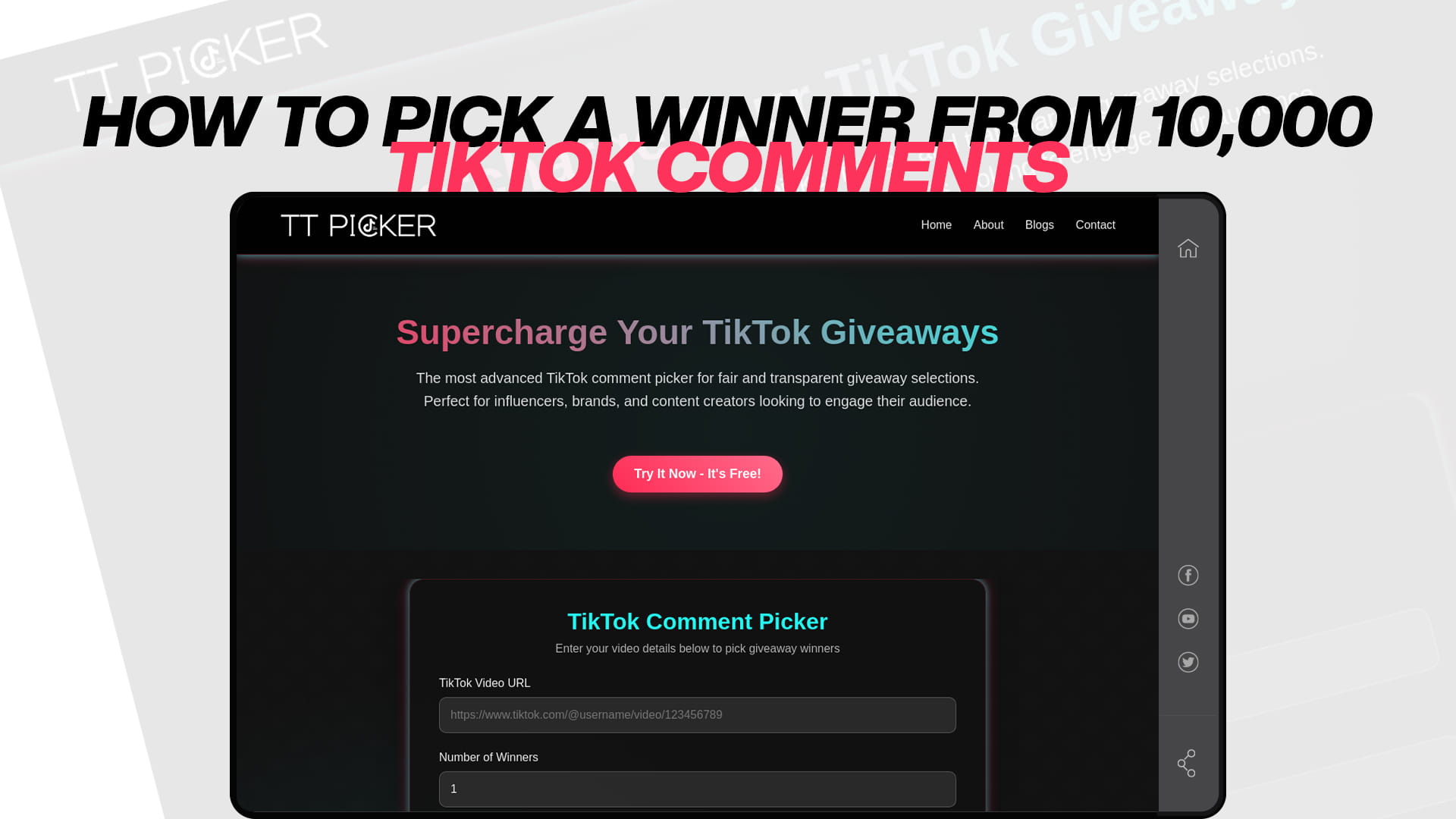
How to Pick a Winner From 10,000 TikTok Comments
Your giveaway went further than you expected. What you planned as a modest contest picked up momentum, the video kept circulating, and now ten thousand comments are sitting under it. This is a good problem, but it is a real one, because almost every method that works fine for a hundred comments quietly breaks at ten thousand.
The most important thing to understand is that the risk at this scale is not that picking becomes difficult. It is that picking becomes unfair without you noticing. This guide covers how to draw a winner from a very large comment pool, what silently goes wrong, and how to keep the result genuinely fair when your entry list runs into five figures.
Why manual picking is not merely hard, it is impossible
Let us dispose of the obvious option first. Scrolling ten thousand comments to pick a winner is not a slow version of a good process, it is not a process at all.
TikTok loads comments progressively as you scroll, so you would be scrolling for a very long time and still could not be confident you had seen everything. You cannot track who has commented more than once across that volume. You cannot check which comments contained your required keyword. And whatever you eventually land on, you have no way to demonstrate it came from a fair consideration of all ten thousand entrants, because it did not.
At small scale, hand-picking is merely biased. At this scale it is a fiction. So the question is not whether to use a tool, but which one and how to configure it.
The problem almost nobody notices: silent comment caps
This is the single most important point in this article, and it catches out an enormous number of creators.
Many comment picker tools cap how many comments they will read on their free tier. Some stop at a few dozen. Some stop at a few hundred. The critical detail is that they usually do not fail loudly. They load their maximum, present you with a tidy pool, and let you draw a winner from it as though everything is fine.
Think about what that means with ten thousand entrants. If a tool reads the first five hundred comments and you draw from those, then ninety-five percent of the people who entered your giveaway had exactly zero chance of winning. Not a small chance. Zero. Your announcement will say the winner was drawn at random from all valid entries, and that statement will be false, and you will not know it.
This is not a minor technical inconvenience; it is a fairness failure and an honesty problem. If your rules promised a random draw from all entries, a capped read means you did not deliver one.
So before you draw from a large pool, verify that your tool actually read all of it. Check the entry count the tool reports against the comment count on your video. If the tool says it loaded 500 and TikTok says you have 10,000 comments, stop and use something else. A picker without a low free-tier cap, like TT Picker, is built to read a full comment pool rather than stopping at an arbitrary ceiling, which is precisely what a large giveaway requires. The reasoning behind that design is covered in the overview of the most advanced TikTok comment picker.
Step one: let it load completely, and check the number
With a very large video, loading is not instant. Give the tool time to pull the full comment set rather than assuming it has finished the moment something appears on screen.
Then do the check described above: compare the number of comments the tool reports against the number TikTok displays on the video. They will rarely match to the digit, because TikTok's displayed count can lag, includes replies in ways that vary, and shifts as people comment and delete. But they should be in the same neighbourhood. Ten thousand on the video and nine thousand and change in the tool is normal variance. Ten thousand on the video and four hundred in the tool is a cap, and you should not draw from it.
Make this check a habit for any giveaway large enough that you cannot eyeball the comment section. It takes five seconds and it is the difference between a real random draw and an accidental fraud.
Step two: filter, because scale multiplies your spam
At a hundred comments you can glance at the section and get a feel for it. At ten thousand, the composition of your pool has almost certainly changed in ways you cannot see, and filtering stops being optional.
Duplicate entries scale disproportionately. Big giveaways attract people who comment repeatedly to improve their odds, and a handful of enthusiastic or strategic entrants can account for hundreds of comments between them. If you draw from an unfiltered pool, those people hold a wildly outsized share of the tickets while everyone who followed your one-entry rule holds a single ticket each. Turn on duplicate filtering so each account collapses to one entry, which is covered in detail in the guide to a comment picker without duplicates.
Bot and spam comments also scale. Viral giveaway videos attract automated accounts, and a large pool will contain more of them in absolute terms. A keyword filter is your best defence here, because most spam does not bother to include your required word. If your rules asked people to comment a specific keyword, applying that filter can cut a ten-thousand-comment pool down to the genuine entries dramatically.
Off-topic comments matter too. A video that went viral collected comments from people who were never entering; they were reacting to the content, arguing in the replies, or just passing through. Without a keyword filter, all those people are in your draw, which is unfair to those who actually entered as instructed.
The practical effect is that ten thousand raw comments might become four thousand valid, de-duplicated entries. That smaller number is your real entry pool, and it is the honest one to draw from and to quote in your announcement.
Step three: draw, including your backups
With a clean pool, the draw itself is instant regardless of size. A tool handles ten thousand entries as easily as ten.
Set your winner count, and add backups in the same pass. At this scale, backups matter more than usual for a specific reason: with a very large, partly anonymous pool, the chance that your drawn winner is inactive, unreachable, or turns out to be a bot is meaningfully higher than in a small giveaway where you half-recognise your regulars. Drawing two or three alternates in the same recorded pass costs nothing and saves you from a second draw later, which always looks worse. Multi-winner mechanics are covered in the guide to multiple winner selection.
If your giveaway has several prizes, draw them all at once too, so the tool removes each winner from the pool as it goes and nobody can be selected twice.
Step four: proof matters more when the pool is huge
Here is the counterintuitive part. You might assume a giveaway with ten thousand entrants is harder to scrutinise, so proof matters less. The opposite is true.
A large giveaway has thousands of people who did not win, many of whom do not know you, have no built-up trust in you, and are primed by experience to assume online giveaways are rigged. A bare name in a caption will attract scepticism at a volume a small giveaway never generates.
So record the draw. Screen-record the moment the filtered pool is visible and the winner is selected, in one continuous take, and make that recording part of your announcement. Say the real entry number out loud: "9,842 comments, 4,113 valid entries after removing duplicates and non-keyword comments, one winner drawn at random." That specificity is enormously reassuring, because it shows you understood your own pool rather than waving at it.
Step five: verify before you announce
Take thirty seconds to check the drawn winner before you post. At this scale, the odds that a bot slipped through your filters and landed on the winning slot are not negligible.
Look at the account: does it have real content and a plausible profile, or is it the empty, generic, random-digits pattern of an automated account? Did their comment genuinely follow your entry rule? If your rules required a follow, check it, since no tool can verify that automatically. If they fail, quietly move to the backup you already drew and verify that one instead.
Doing this before you announce, rather than after, is what keeps a large giveaway clean. Retracting a public winner in front of ten thousand people is a far worse afternoon than a thirty-second profile check.
What to expect from a viral giveaway pool
A few realities of very large pools are worth knowing in advance so nothing surprises you.
Your valid entry count will be much lower than your comment count, often dramatically so once duplicates, spam, and off-topic comments come out. That is normal and healthy, not a sign something went wrong. Your winner is statistically likely to be someone you have never interacted with, because strangers dominate the pool, so do not be alarmed when the name means nothing to you. And a meaningful share of your new followers from a viral giveaway will not stick, which is a known cost of reach that arrives with a generic prize.
None of these change how you run the draw. They just set expectations so you interpret the result correctly.
Picking a winner from ten thousand comments is technically easy and ethically delicate. The tool does the work in seconds, but only if it actually reads your whole pool, so check the loaded count, filter hard for duplicates and keywords, draw your winner and backups in one recorded pass, and verify before announcing. Do that and a giveaway that got away from you becomes the most convincing one you have ever run, because thousands of people watched a draw they could see was fair.
Frequently Asked Questions
A good one can, but many free tools cap how many comments they read, sometimes at a few dozen or a few hundred. Always compare the entry count your tool reports against the comment count on your video, and use a picker without a low free-tier cap for large giveaways.
Everyone beyond the cap is silently excluded from the draw, so if it reads 500 of 10,000, ninety-five percent of your entrants had no chance of winning at all. Your announcement claiming a random draw from all entries would then be inaccurate, which is why checking the loaded count matters.
Because duplicates collapse to one entry per person, spam and bot comments get filtered, and off-topic comments from people who were never entering are removed by your keyword filter. On a viral video, a large gap between raw comments and valid entries is completely normal.
Especially on a giveaway this big. Large pools attract repeat commenters, and a handful of people posting hundreds of comments between them can take an outsized share of the draw. Duplicate filtering is what keeps your stated one-entry-per-person rule true.
Two or three. With a large, mostly anonymous entrant pool, the chance that your winner is inactive, unreachable, or a bot is higher than in a small giveaway, so having alternates already selected in the same recorded draw saves you from running a second draw later.