
How Do Comment Pickers Work — Are They Actually Random?
Every creator who has run a giveaway has had the same nagging thought at the winner stage: is this tool actually picking at random, or is something fishy going on behind the scenes? It is a fair question. You are about to hand over a prize and stake your credibility on the result, so you deserve to know what the picker is really doing.
The short version is that yes, reputable comment pickers are genuinely random, and they are far fairer than any human scrolling and stopping on a comment. But "random" is a word that hides some interesting detail, and understanding what is happening under the hood is the difference between trusting a tool blindly and being able to explain to your audience exactly why the draw was fair. This is how comment pickers actually work, and an honest answer to whether they are random.
What a comment picker actually does
Strip away the interface and a comment picker does three things in sequence: it fetches the comments from your post, it filters them down to valid entries, and it selects a winner at random from what remains. Each stage matters, and fairness depends on all three, not just the last one.
People obsess over the randomness of the final pick, which is reasonable, but the fetching and filtering stages quietly shape the outcome just as much. A tool that only grabs half the comments, or counts the same person ten times, is not fair no matter how good its random number generator is. So it is worth understanding the whole pipeline.
Stage one: fetching the comments
When you paste your video link into a TikTok comment picker, the first thing it does is pull the comments from that post. Good tools read only what is publicly visible, which is why you do not need to hand over your password. You are pointing the tool at a public post and asking it to read what anyone could already see.
This stage has real-world limits worth knowing about. A picker can only select from comments it can actually access, so if comments are disabled, the video is private, or the post was removed, the tool has nothing to work with. There can also be limits on how many comments a tool retrieves in one go, and some free tools cap the pool at a set number per post. The better-built ones are designed to handle videos with thousands of comments, which matters once a giveaway takes off.
The practical takeaway is to make sure the tool actually loaded all your entries before you draw. If your video has two thousand comments and the picker shows it pulled two hundred, the draw is only fair relative to that smaller pool, not your whole giveaway. Check the entry count the tool reports against what you can see on the post.
Stage two: filtering the entries
Raw comments are messy. People comment twice, they comment without following your rule, they reply to other comments, and a few spam the section trying to improve their odds. Filtering turns that mess into a clean list of valid entries, and it is a core part of fairness rather than an optional extra.
Typical filters include removing duplicate comments so one person does not get counted ten times, matching a keyword or hashtag so only people who followed your entry instructions are included, deciding whether replies count as entries, requiring a minimum number of tagged friends, and excluding specific accounts such as your own or previous winners. Each filter enforces a rule you set in advance, which is exactly what keeps the draw consistent with the giveaway you advertised.
This is where "every entry has an equal chance" actually gets defined. If you said one entry per person, duplicate filtering is what makes that true. If you said comment a specific word, keyword filtering is what enforces it. The rundown of TT Picker as a giveaway and contest tool goes deeper on how these filters fit together, but the principle is simple: filtering decides who is in the hat, and the random pick decides who comes out of it.
Stage three: the random selection
Now the part everyone actually asks about. Once you have a clean list of valid entries, how does the tool pick one?
Conceptually it is simple. Every entry gets a position in the list, say one through five hundred. The tool then generates a random number in that range and selects the entry at that position. There is, as one picker bluntly puts it, no magic to it. The fairness of the whole thing comes down to one thing: how good is the random number it generates?
This is where the technical detail lives. Most comment pickers use a pseudo-random number generator, usually shortened to PRNG. A PRNG is an algorithm that produces a sequence of numbers that is statistically random, meaning the numbers are uniformly spread and show no predictable pattern, starting from an initial value called a seed. Better tools use a cryptographically secure random number generator, a CSPRNG, which is the same class of randomness trusted in cryptography and online security. Some pair it with a Fisher-Yates shuffle, a well-established method for shuffling a list so that every possible ordering is equally likely, which makes the result reproducible and verifiable.
That is the honest mechanism. No favoritism, no hidden weighting, just a number generated and a position selected.
So are they actually random?
Here is the nuanced, honest answer, because "random" turns out to have two meanings and they get muddled constantly.
In the strict, philosophical sense, a PRNG is not "true" randomness. It is a deterministic algorithm: feed it the same seed and it produces the same sequence. True randomness, in the purest sense, comes from physical sources of unpredictability like atmospheric or thermal noise. So if your question is "is this the same as radioactive decay generating pure entropy," then technically, for most pickers, no.
But that is the wrong test for a giveaway. What you actually need from a fair draw is three things: every valid entry has an equal probability of being chosen, the outcome cannot be predicted in advance, and nobody can manipulate the result to favor a particular entry. A decent PRNG delivers all three, and a CSPRNG delivers them to a standard far beyond anything a giveaway requires. For the purpose of picking a winner fairly, statistically random and unbiased is exactly what fair means. The distinction between pseudo-random and true random is real, but it has no practical effect on whether your giveaway is fair.
It helps to compare the alternative. When you pick by hand, you are not random at all. You unconsciously gravitate toward names you recognize, comments near the top, accounts with nice profile pictures, or the friend you secretly hoped would win. Even when you try hard to be fair, you cannot prove you were, and your audience has no reason to believe you. A computer has no preferences. It does not like or dislike any entrant. It simply generates a number, which is precisely why it is more trustworthy than human judgment, not less.
So the real answer is: yes, reputable comment pickers are random in every way that matters for a fair giveaway, and they remove the bias that creeps in when a person chooses. The pseudo-random caveat is true but practically irrelevant.
Random is necessary, but transparency is what earns trust
Here is the part that matters more than the choice of algorithm. Your audience cannot see your tool's random number generator. They have no way to inspect the code. So the randomness alone, however good, does not automatically convince anyone. What convinces people is transparency: being able to show how the winner was chosen.
This is why the best pickers do not just pick, they document. A complete record of the selection, showing the winning username and comment, a timestamp, and confirmation that the random process ran, gives you something concrete to show your audience. Recording the draw on screen does the same job. The walkthrough on how TT Picker selects winners randomly covers the documentation side, and it is worth pairing with your winner announcement so the proof and the reveal travel together. If you want the templates for that announcement, the guide on how to announce a giveaway winner covers it.
The point is that fairness and the appearance of fairness are two different problems. A good random algorithm solves the first. Showing your work solves the second. You need both.
How to tell whether a picker is actually fair
Not every tool deserves your trust, so here is how to judge one.
Look for an equal-chance guarantee. The tool should state plainly that every valid entry has the same probability of being selected, with no paid weighting or hidden boosts.
Look for real filtering. Duplicate removal and keyword matching are not just convenience features, they are what make the draw match your stated rules. A tool without them cannot enforce "one entry per person."
Look for transparency features. A visible entry count, an on-screen draw you can record, and a documented result with a timestamp all let you prove the outcome rather than just assert it.
Check that it reads public data without demanding your password. A picker should work from your public post, not your login credentials.
And be wary of any tool that offers to change the outcome, lets you re-roll endlessly until you like the winner, or charges to influence results. Those features exist to undermine fairness, not support it. A reputable tool draws once, shows its work, and stands by the result.
What about bots and fake entries?
A reasonable follow-up question is whether the randomness even matters if the entry pool is full of bots or fake accounts. It is a fair concern, and it is worth being clear about what a comment picker can and cannot do here.
A picker selects randomly from the entries it is given, so if a giveaway attracts spam accounts, those accounts are technically in the pool. What a good picker does is reduce their advantage rather than eliminate the accounts entirely. Duplicate filtering stops one bot from flooding the comments with fifty entries to stack the odds, which is the most common manipulation tactic. Keyword requirements add a small hurdle that low-effort bots often fail. And excluding specific accounts lets you remove ones you have already spotted.
The rest is on you at the verification stage. This is exactly why you contact the winner privately and confirm they meet your eligibility rules before announcing publicly. If the drawn account turns out to be fake or ineligible, your rules should let you disqualify it and draw again. The randomness is honest, but it works on the pool you hand it, so clean entries and a verification step are what make the final result solid.
Where TT Picker lands
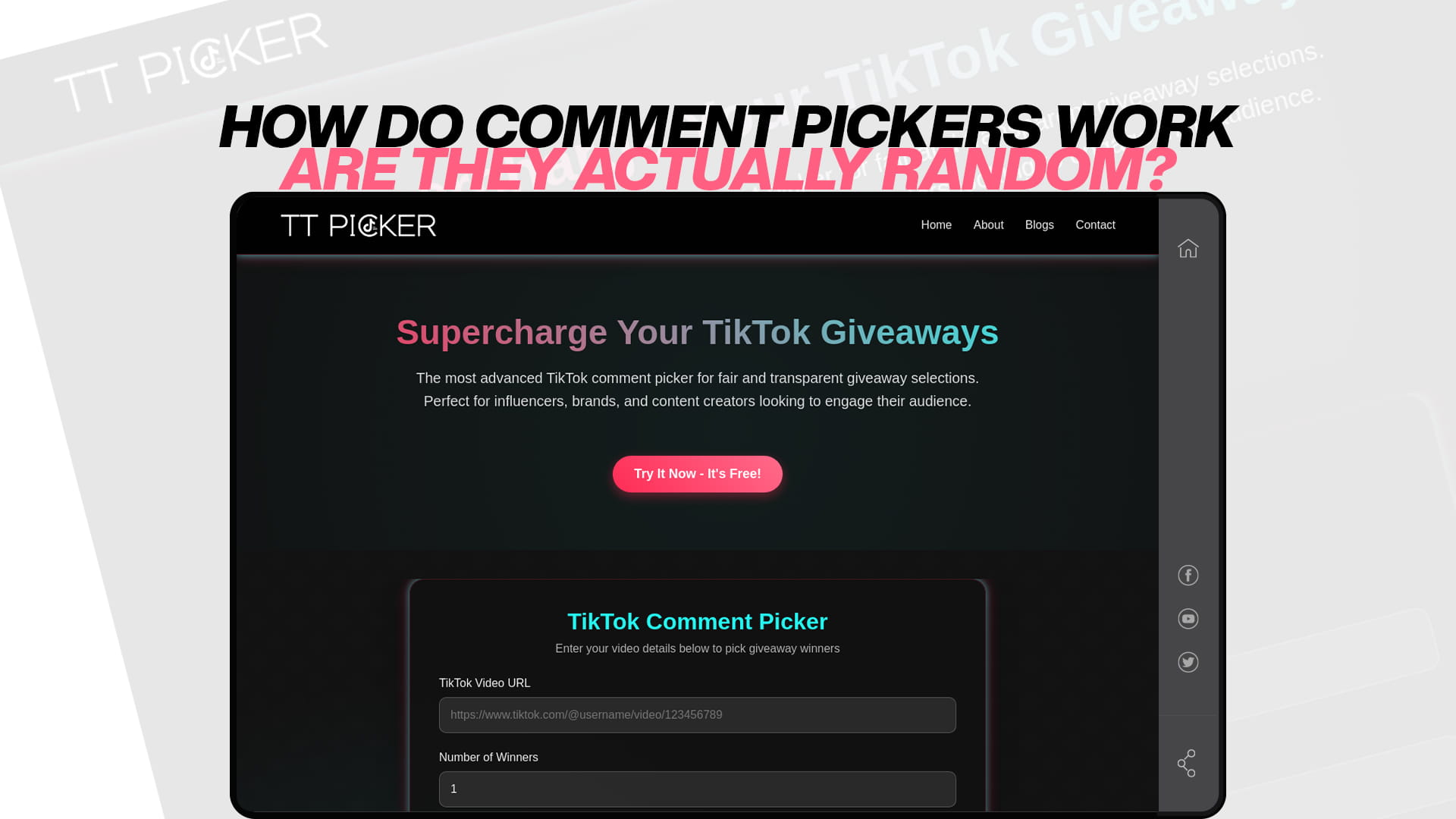
To make this concrete: TT Picker collects the comments from any public TikTok video, lets you filter by keyword and decide whether replies count, handles videos with thousands of comments, and selects the winner using a genuinely random, cryptographically secure selection so that every comment has an equal chance. Crucially, it shows the winning username and comment and provides a record of the selection, including the timestamp, so you have the documentation to back up your announcement. No account, no download, and the draw is something you can put on camera. The overview of TT Picker as the most advanced TikTok comment picker goes into the filtering and selection in more depth.
That combination, real randomness plus visible proof, is the whole answer to the question. Comment pickers are random in the way that counts, they are dramatically fairer than picking by hand, and the good ones let you prove it. So the next time someone in your comments wonders whether the draw was rigged, you will not just be able to say it was fair. You will be able to show them exactly why.